[05/08] EVIDENCE CLUSTER · RATE

Electron screening accelerator measurements in metals

The quantitative core: screening potentials of tens to hundreds of electronvolts by host metal, structure and temperature, our rate lever.

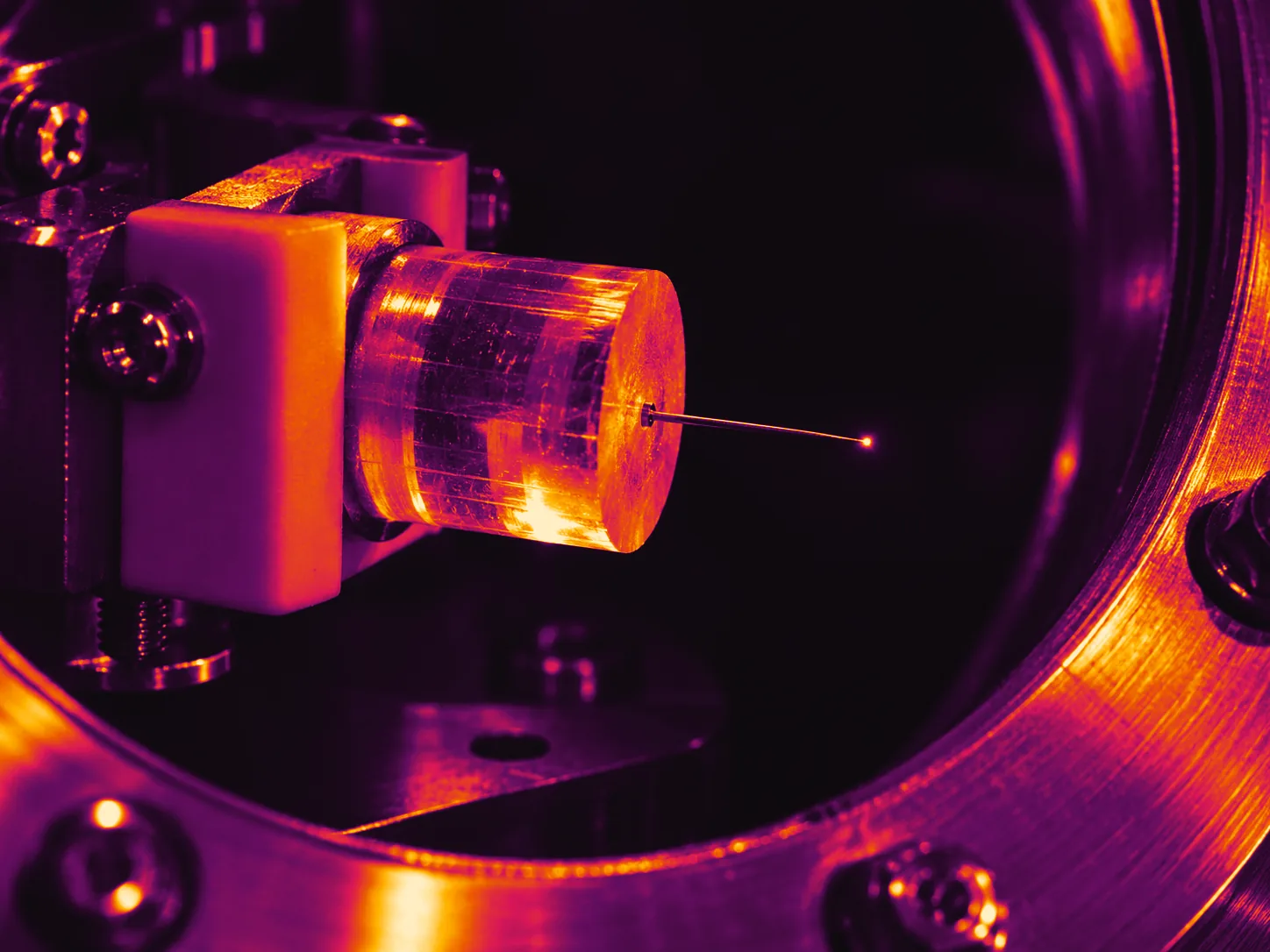
Illustrative photograph: a stainless accelerator beamline with a viewport target chamber, bellows and bolted flanges[Illustrative image]

[ITS JOB IN THE DEVICE]

Multiply the rate. This cluster sets the rate lever (screening).

Hosts ranked by measured screening: 300 eV class in Pd, Ta, Zr; up to 800 ± 90 eV in Pd See all 7 lessons ↓

records
12
years
1995–2023
papers cited
12
with a DOI
10

[12 OF 84 RECORDS · 1986 TO 2026]each bar opens its row

[WHAT WE CARRY INTO THE DEVICE]

What we carry
into the device.

The payoff of this record for the program: 7 design decisions, each tied to what was measured. They feed one input of the device.

[THE SIX DESIGN INPUTS]

  1. Shake it 0208
  2. Make the field 06
  3. Choose the host 04
  4. Load it, measure it 0103
  5. Multiply the rate 05
  6. Hit the target 07

Carry into device, in the full document

  1. 01

    Host selection by confirmed screening value

    Palladium, tantalum and zirconium sit at the 300 eV class with the tightest error bars; palladium's 800 plus or minus 90 eV LUNA value, if transferable off the beam platform, is the single most valuable number in the field and our first test target. Titanium belongs on the list only in its cubic (hydride) phase.

  2. 02

    Defect engineering is a first-class lever

    The record ties screening strength to cold work, vacancy population and deuteron trapping. Our shear-thickening suspension runs on crushed and milled powders, so it lives in the high-defect regime by construction; we should quantify vacancy densities on witness foils with PAS before and after mechanical excitation, and treat annealing as the negative control the record already provides.

  3. 03

    Surface discipline

    Oxide layers suppress measured screening (zirconium 295 versus 80 eV), yet the gas-loading cluster shows deliberate re-oxidation restores hydride energetics after aging. Specify oxide state per batch, load powders in deuterium gas before suspension, and log both.

  4. 04

    Electron density and effective mass are design variables we can compute

    Rank candidate hosts (palladium, nickel, zirconium, titanium, lanthanum-nickel hydride-forming alloys) by Thomas-Fermi screening estimates and effective electron mass before spending beam time; the 58-sample Raiola survey is the validation set for such a ranking.

  5. 05

    Beam-off discrimination is our structural advantage

    The known artifact channel (deuteron-density dynamics in implanted targets) does not exist in a suspension device, where deuterons are born in the lattice and accelerated across gaps mechanically. Any signal we see is not that artifact class.

  6. 06

    Temperature mapping

    Screening varies measurably with host temperature (platinum 20 to 340 degrees C study); our device sweeps temperature during ultrasound and piezo drive, so witness-target screening should be characterized at the same temperatures as the device runs.

  7. 07

    Arithmetic to carry

    100 to 300 eV of screening multiplies deuteron-deuteron rates by 1e4 to 1e11 across the 0.5 to 1 keV window (estimate). Every volt we add across a piezo gap is worth more at lower deuteron energy, which fixes our optimization target: maximize gap field at the lowest credible gap crossing energy.

[THE RECORD]

12 records,
1995 to 2023.

[HOW THIS RECORD WAS COMPILED]

Vantasner AG device program: prior art briefing. Concept source read 2026-10-21; every citation below was confirmed by web search on 2026-10-21. Records are reported neutrally: who, when, venue and digital object identifier (DOI), setup, materials, loading, excitation, conditions, and reported outputs. This cluster is the quantitatively established core of condensed-matter nuclear science: accelerator teams shooting kiloelectronvolt deuterons into deuterated metals measure reaction yields far above the bare-nucleus curve, and the fitted energy shift, called the screening potential, runs from tens to hundreds of electronvolts depending on the host. Those numbers are the bridge between chemical-scale energies and nuclear rates, and they are the numbers our piezo-gap acceleration concept multiplies against.

[RAW TABLE] [IN THE FULL DOCUMENT →] Sorted by year. #N is the row number in the repo table.
  1. 1995 #1

    U. Greife et al.

    Ruhr-Universitaet Bochum

    Zeitschrift fuer Physik A 351: 107 (1995) no DOILibrary →

    Setup
    gas-target deuteron-deuteron (D-D) fusion at very low beam energy; the baseline experiment for the field
    Reported
    the record shows a gas-target screening energy of 25 plus or minus 5 eV, quoted by later groups as the atomic-limit baseline
    Materials, loading, excitation, conditions for record 1
    Materials
    deuterium gas target
    Loading
    molecular D2
    Excitation
    deuteron beam, 5 to 10 keV class
    Conditions
    precision cross sections below 10 keV center-of-mass
    Who
    U. Greife and co-workers (Ruhr-Universitaet Bochum)
    When · venue
    1995 · Zeitschrift fuer Physik A 351: 107 (1995)
  2. 1998 #2

    H. Yuki et al.

    Tohoku University

    JETP Letters 68: 823-829 (1998) DOI ↗Library →

    Setup
    deuteron beam on deuterated metal targets; d(d,p)t yields at low energy
    Reported
    the authors report enhanced D-D yields in metallic environments relative to gas, among the first metal-host measurements of this kind
    Materials, loading, excitation, conditions for record 2
    Materials
    metal targets including titanium and gold
    Loading
    deuterium absorbed in the metal target
    Excitation
    low-energy deuteron beam
    Conditions
    sub-10 keV class beam energies
    Who
    H. Yuki and co-workers (Tohoku University)
    When · venue
    1998 · JETP Letters 68: 823-829 (1998), DOI 10.1134/1.567800
  3. 2001 #3

    K. Czerski et al.

    Technische Universitaet Berlin

    Europhysics Letters 54 (4): 449-455 (2001) DOI ↗Library →

    Setup
    deuteron implantation into three metal targets to saturation stoichiometry; thick-target yields of d(d,p)t and d(d,n)he3 at four detector angles 90 to 150 degrees
    Reported
    the authors report screening energies of 190 plus or minus 15 eV (Al), 297 plus or minus 8 eV (Zr), 322 plus or minus 15 eV (Ta), about ten times the 25 plus or minus 5 eV gas value and a clear host-material dependence; theoretical estimates (about 20 eV gas, about 80 eV palladium bound-state limit) fall far below
    Materials, loading, excitation, conditions for record 3
    Materials
    aluminum, zirconium, tantalum foils implanted with deuterium (D+, D2+ beams)
    Loading
    implantation to saturation, near chemical stoichiometry
    Excitation
    5 to 60 keV deuteron beams; 60 kV cascade accelerator, high-voltage stability about 10 eV
    Conditions
    thick targets; on-line deuteron-density monitoring via proton yield
    Who
    K. Czerski, A. Huke, A. Biller, P. Heide, M. Hoeft, G. Ruprecht (Technische Universitaet Berlin)
    When · venue
    2001 · Europhysics Letters 54 (4): 449-455 (2001), DOI 10.1209/epl/i2001-00265-7
  4. 2002 #4

    F. Raiola et al.

    Laboratory for Underground Nuclear Astrophysics, LNGS and partners

    European Physical Journal A 13: 377-382 (2002) DOI ↗Library →

    Setup
    accelerator screening measurement of d(d,p)t in tantalum
    Reported
    the authors report a tantalum screening energy of 309 plus or minus 12 eV, matching the Berlin value within errors
    Materials, loading, excitation, conditions for record 4
    Materials
    deuterated tantalum target
    Loading
    deuteron implantation
    Excitation
    low-energy deuteron beam (LUNA 50 kV class accelerator)
    Conditions
    underground laboratory conditions
    Who
    F. Raiola and co-workers, LUNA Collaboration (Laboratory for Underground Nuclear Astrophysics, LNGS and partners)
    When · venue
    2002 · European Physical Journal A 13: 377-382 (2002), DOI 10.1007/s10050-002-8766-5
  5. 2002 #5

    F. Raiola et al.

    Bochum, Atomki, LUNA partners

    Physics Letters B 547: 193-199 (2002) DOI ↗Library →

    Setup
    d(d,p)t screening across deuterated metals; ordering against the periodic table
    Reported
    the authors report a palladium screening energy of 800 plus or minus 90 eV (quoted by Czerski and co-workers 2004), the largest value in the d(d,p)t record, and periodic-table ordering of screening strengths
    Materials, loading, excitation, conditions for record 5
    Materials
    multiple deuterated metal targets, flagship result palladium
    Loading
    deuteron implantation into metals
    Excitation
    low-energy deuteron beams
    Conditions
    same beam-energy class as the Berlin campaign
    Who
    F. Raiola, P. Migliardi, L. Gang and co-workers (Bochum, Atomki, LUNA partners)
    When · venue
    2002 · Physics Letters B 547: 193-199 (2002), DOI 10.1016/S0370-2693(02)02774-0
  6. 2002 #6

    J. Kasagi et al.

    Tohoku University

    Journal of the Physical Society of Japan 71: 2281 (2002) no DOILibrary →

    Setup
    deuteron beam screening measurement on palladium
    Reported
    the authors report a palladium screening energy of 310 plus or minus 50 eV (quoted by Czerski and co-workers 2004), agreeing with the Berlin palladium value
    Materials, loading, excitation, conditions for record 6
    Materials
    deuterated palladium
    Loading
    deuteron loading of palladium
    Excitation
    low-energy deuteron beam
    Conditions
    keV-class beam energies
    Who
    J. Kasagi and co-workers (Tohoku University)
    When · venue
    2002 · Journal of the Physical Society of Japan 71: 2281 (2002)
  7. 2003 #7

    C. Bonomo et al.

    Bochum, INFN partners

    Nuclear Physics A 719: 37c (2003) DOI ↗Library →

    Setup
    screening measurements with in-situ surface cleaning by krypton sputtering
    Reported
    the authors report that sputter-cleaning raises the measured screening energy for aluminum and other metals; Czerski and co-workers 2004 attribute the small early values for zirconium (80 plus or minus 20 eV class) to surface re-oxidation
    Materials, loading, excitation, conditions for record 7
    Materials
    aluminum and other metal targets
    Loading
    deuteron implantation
    Excitation
    low-energy deuteron beams; sputter cleaning immediately before measurement
    Conditions
    high-vacuum conditions, re-oxidation within minutes at 10 to the minus 8 mbar for reactive metals
    Who
    C. Bonomo and co-workers (Bochum, INFN partners)
    When · venue
    2003 · Nuclear Physics A 719: 37c (2003), DOI 10.1016/S0375-9474(03)00955-2
  8. 2004 #8

    F. Raiola et al.

    Bochum-led collaboration

    European Physical Journal A 19 (2): 283-287 (2004) DOI ↗Library →

    Setup
    systematic d(d,p)t screening survey: 58 samples spanning metals, insulators, semiconductors
    Reported
    the authors report large screening in most metals, small (gas-like) values in insulators, semiconductors and lanthanides, periodic-table ordering of the effect, and suggest classical Debye-type plasma screening by quasi-free metallic electrons as a candidate mechanism
    Materials, loading, excitation, conditions for record 8
    Materials
    deuterated metals, insulators, semiconductors, lanthanides
    Loading
    deuteron implantation / gas absorption per sample
    Excitation
    low-energy deuteron beams versus a gaseous D2 reference
    Conditions
    identical beam-energy class across all 58 samples
    Who
    F. Raiola and 26 co-workers (Bochum-led collaboration)
    When · venue
    2004 · European Physical Journal A 19 (2): 283-287 (2004), DOI 10.1140/epja/i2003-10125-0
  9. 2004 #9

    K. Czerski et al.

    Hahn-Meitner-Institut Berlin, TU Berlin

    Europhysics Letters 68 (3): 363-369 (2004) DOI ↗Library →

    Setup
    five-target screening study plus improved dielectric-function theory and extrapolation to room-temperature energies
    Reported
    the authors report screening energies of minus 20 plus or minus 5 eV (C), 191 plus or minus 12 eV (Al), 295 plus or minus 7 eV (Zr), 296 plus or minus 15 eV (Pd), 302 plus or minus 13 eV (Ta); theory (polarization plus cohesion, 14 to 136 eV) tracks the material trend but sits about a factor 2 low; with moving target deuterons, a 220 eV effective screening fits the Jones-type neutron rates while the Fleischmann-Pons heat rate would demand about 620 eV
    Materials, loading, excitation, conditions for record 9
    Materials
    carbon (amorphous), aluminum (AlD), zirconium (ZrD2), palladium (PdD0.2, deliberately implanted only to 0.2 stoichiometry to limit lattice defects), tantalum (TaD)
    Loading
    deuteron implantation at the listed stoichiometries
    Excitation
    5 to 60 keV D+ and D2+ beams
    Conditions
    thick targets; angular-distribution-corrected yields
    Who
    K. Czerski, A. Huke, P. Heide, G. Ruprecht (Hahn-Meitner-Institut Berlin, TU Berlin)
    When · venue
    2004 · Europhysics Letters 68 (3): 363-369 (2004), DOI 10.1209/epl/i2004-10209-3
  10. 2005 #10

    F. Raiola et al.

    LUNA Collaboration partners

    Journal of Physics G: Nuclear and Particle Physics 31 (11) DOI ↗Library →

    Setup
    temperature-dependence study of d(d,p)t screening in metals
    Reported
    the authors report the temperature dependence of the measured screening energy in metallic hosts, the experimental handle on how thermal conditions modulate screening
    Materials, loading, excitation, conditions for record 10
    Materials
    deuterated platinum and cobalt targets
    Loading
    deuteron implantation
    Excitation
    low-energy deuteron beams; sample stage heated
    Conditions
    platinum at 20 to 340 degrees C; cobalt at 20 and 200 degrees C
    Who
    F. Raiola, B. Burchard, Z. Fulop, G. Gyurky and co-workers (LUNA Collaboration partners)
    When · venue
    2005 · Journal of Physics G: Nuclear and Particle Physics 31 (11), DOI 10.1088/0954-3899/31/11/002
  11. 2008 #11

    A. Huke et al.

    TU Berlin, University of Szczecin, TRIUMF

    Physical Review C 78: 015803 (2008) DOI ↗arXiv ↗Library →

    Setup
    new differential yield analysis method applied to deuteron-implanted metals; systematic study of surface and deuteron-density artifacts
    Reported
    the authors report zirconium 297 plus or minus 8 eV, palladium 313 plus or minus 2 eV, and tantalum spanning 213 to 462 eV depending on surface state; they show target surface contamination and deuteron-density dynamics can distort screening values, and they exclude the Debye-Hueckel model as the mechanism
    Materials, loading, excitation, conditions for record 11
    Materials
    zirconium, palladium, tantalum targets under multiple surface conditions
    Loading
    deuteron implantation, on-line density monitoring
    Excitation
    5 to 50 keV deuteron beams
    Conditions
    varied target surface histories (four tantalum conditions)
    Who
    A. Huke, K. Czerski, P. Heide, G. Ruprecht, N. Targosz, W. Zebrowski (TU Berlin, University of Szczecin, TRIUMF)
    When · venue
    2008 · Physical Review C 78: 015803 (2008), DOI 10.1103/PhysRevC.78.015803 (preprint arXiv:0805.4538)
  12. 2023 #12

    A. Kowalska et al.

    University of Szczecin eLBRUS laboratory and partners

    Materials 16 (18): 6255 (2023) DOI ↗Library →

    Setup
    positron annihilation spectroscopy (PAS) and X-ray diffraction (XRD) on deuteron-irradiated zirconium from the ultra-high vacuum (UHV) accelerator campaign
    Reported
    the review section records the field situation: observed deuteron-deuteron screening energies of order 400 eV against about 100 eV theoretical, resolved toward theory in the atomically clean UHV zirconium experiment; cold-rolled palladium shows high screening while annealed palladium does not; cubic-structure titanium shows high screening while hexagonal-phase titanium shows small values; density functional theory (DFT) results allow up to nine hydrogen atoms trapped per zirconium vacancy
    Materials, loading, excitation, conditions for record 12
    Materials
    cold-rolled zirconium foils, deuteron plus carbon/oxygen ion implanted
    Loading
    deuteron irradiation producing vacancies and zirconium deuteride (ZrH1.5-phase) formation
    Excitation
    10 to 20 keV and 80 keV deuteron beams plus 200/240 keV C and O ions
    Conditions
    UHV conditions; defect depth profiling to about 600 nm
    Who
    A. Kowalska, K. Czerski, P. Horodek, K. Siemek and co-workers (University of Szczecin eLBRUS laboratory and partners)
    When · venue
    2023 · Materials 16 (18): 6255 (2023), DOI 10.3390/ma16186255
The record table exactly as written in the repo (12 rows × 9 columns; scrolls sideways)
whowhenvenue / DOIsetupmaterialsloadingexcitationconditionsreported outputs
U. Greife and co-workers (Ruhr-Universitaet Bochum)1995Zeitschrift fuer Physik A 351: 107 (1995)gas-target deuteron-deuteron (D-D) fusion at very low beam energy; the baseline experiment for the fielddeuterium gas targetmolecular D2deuteron beam, 5 to 10 keV classprecision cross sections below 10 keV center-of-massthe record shows a gas-target screening energy of 25 plus or minus 5 eV, quoted by later groups as the atomic-limit baseline
H. Yuki and co-workers (Tohoku University)1998JETP Letters 68: 823-829 (1998), DOI 10.1134/1.567800deuteron beam on deuterated metal targets; d(d,p)t yields at low energymetal targets including titanium and golddeuterium absorbed in the metal targetlow-energy deuteron beamsub-10 keV class beam energiesthe authors report enhanced D-D yields in metallic environments relative to gas, among the first metal-host measurements of this kind
K. Czerski, A. Huke, A. Biller, P. Heide, M. Hoeft, G. Ruprecht (Technische Universitaet Berlin)2001Europhysics Letters 54 (4): 449-455 (2001), DOI 10.1209/epl/i2001-00265-7deuteron implantation into three metal targets to saturation stoichiometry; thick-target yields of d(d,p)t and d(d,n)he3 at four detector angles 90 to 150 degreesaluminum, zirconium, tantalum foils implanted with deuterium (D+, D2+ beams)implantation to saturation, near chemical stoichiometry5 to 60 keV deuteron beams; 60 kV cascade accelerator, high-voltage stability about 10 eVthick targets; on-line deuteron-density monitoring via proton yieldthe authors report screening energies of 190 plus or minus 15 eV (Al), 297 plus or minus 8 eV (Zr), 322 plus or minus 15 eV (Ta), about ten times the 25 plus or minus 5 eV gas value and a clear host-material dependence; theoretical estimates (about 20 eV gas, about 80 eV palladium bound-state limit) fall far below
F. Raiola and co-workers, LUNA Collaboration (Laboratory for Underground Nuclear Astrophysics, LNGS and partners)2002European Physical Journal A 13: 377-382 (2002), DOI 10.1007/s10050-002-8766-5accelerator screening measurement of d(d,p)t in tantalumdeuterated tantalum targetdeuteron implantationlow-energy deuteron beam (LUNA 50 kV class accelerator)underground laboratory conditionsthe authors report a tantalum screening energy of 309 plus or minus 12 eV, matching the Berlin value within errors
F. Raiola, P. Migliardi, L. Gang and co-workers (Bochum, Atomki, LUNA partners)2002Physics Letters B 547: 193-199 (2002), DOI 10.1016/S0370-2693(02)02774-0d(d,p)t screening across deuterated metals; ordering against the periodic tablemultiple deuterated metal targets, flagship result palladiumdeuteron implantation into metalslow-energy deuteron beamssame beam-energy class as the Berlin campaignthe authors report a palladium screening energy of 800 plus or minus 90 eV (quoted by Czerski and co-workers 2004), the largest value in the d(d,p)t record, and periodic-table ordering of screening strengths
J. Kasagi and co-workers (Tohoku University)2002Journal of the Physical Society of Japan 71: 2281 (2002)deuteron beam screening measurement on palladiumdeuterated palladiumdeuteron loading of palladiumlow-energy deuteron beamkeV-class beam energiesthe authors report a palladium screening energy of 310 plus or minus 50 eV (quoted by Czerski and co-workers 2004), agreeing with the Berlin palladium value
C. Bonomo and co-workers (Bochum, INFN partners)2003Nuclear Physics A 719: 37c (2003), DOI 10.1016/S0375-9474(03)00955-2screening measurements with in-situ surface cleaning by krypton sputteringaluminum and other metal targetsdeuteron implantationlow-energy deuteron beams; sputter cleaning immediately before measurementhigh-vacuum conditions, re-oxidation within minutes at 10 to the minus 8 mbar for reactive metalsthe authors report that sputter-cleaning raises the measured screening energy for aluminum and other metals; Czerski and co-workers 2004 attribute the small early values for zirconium (80 plus or minus 20 eV class) to surface re-oxidation
F. Raiola and 26 co-workers (Bochum-led collaboration)2004European Physical Journal A 19 (2): 283-287 (2004), DOI 10.1140/epja/i2003-10125-0systematic d(d,p)t screening survey: 58 samples spanning metals, insulators, semiconductorsdeuterated metals, insulators, semiconductors, lanthanidesdeuteron implantation / gas absorption per samplelow-energy deuteron beams versus a gaseous D2 referenceidentical beam-energy class across all 58 samplesthe authors report large screening in most metals, small (gas-like) values in insulators, semiconductors and lanthanides, periodic-table ordering of the effect, and suggest classical Debye-type plasma screening by quasi-free metallic electrons as a candidate mechanism
K. Czerski, A. Huke, P. Heide, G. Ruprecht (Hahn-Meitner-Institut Berlin, TU Berlin)2004Europhysics Letters 68 (3): 363-369 (2004), DOI 10.1209/epl/i2004-10209-3five-target screening study plus improved dielectric-function theory and extrapolation to room-temperature energiescarbon (amorphous), aluminum (AlD), zirconium (ZrD2), palladium (PdD0.2, deliberately implanted only to 0.2 stoichiometry to limit lattice defects), tantalum (TaD)deuteron implantation at the listed stoichiometries5 to 60 keV D+ and D2+ beamsthick targets; angular-distribution-corrected yieldsthe authors report screening energies of minus 20 plus or minus 5 eV (C), 191 plus or minus 12 eV (Al), 295 plus or minus 7 eV (Zr), 296 plus or minus 15 eV (Pd), 302 plus or minus 13 eV (Ta); theory (polarization plus cohesion, 14 to 136 eV) tracks the material trend but sits about a factor 2 low; with moving target deuterons, a 220 eV effective screening fits the Jones-type neutron rates while the Fleischmann-Pons heat rate would demand about 620 eV
F. Raiola, B. Burchard, Z. Fulop, G. Gyurky and co-workers (LUNA Collaboration partners)2005Journal of Physics G: Nuclear and Particle Physics 31 (11), DOI 10.1088/0954-3899/31/11/002temperature-dependence study of d(d,p)t screening in metalsdeuterated platinum and cobalt targetsdeuteron implantationlow-energy deuteron beams; sample stage heatedplatinum at 20 to 340 degrees C; cobalt at 20 and 200 degrees Cthe authors report the temperature dependence of the measured screening energy in metallic hosts, the experimental handle on how thermal conditions modulate screening
A. Huke, K. Czerski, P. Heide, G. Ruprecht, N. Targosz, W. Zebrowski (TU Berlin, University of Szczecin, TRIUMF)2008Physical Review C 78: 015803 (2008), DOI 10.1103/PhysRevC.78.015803 (preprint arXiv:0805.4538)new differential yield analysis method applied to deuteron-implanted metals; systematic study of surface and deuteron-density artifactszirconium, palladium, tantalum targets under multiple surface conditionsdeuteron implantation, on-line density monitoring5 to 50 keV deuteron beamsvaried target surface histories (four tantalum conditions)the authors report zirconium 297 plus or minus 8 eV, palladium 313 plus or minus 2 eV, and tantalum spanning 213 to 462 eV depending on surface state; they show target surface contamination and deuteron-density dynamics can distort screening values, and they exclude the Debye-Hueckel model as the mechanism
A. Kowalska, K. Czerski, P. Horodek, K. Siemek and co-workers (University of Szczecin eLBRUS laboratory and partners)2023Materials 16 (18): 6255 (2023), DOI 10.3390/ma16186255positron annihilation spectroscopy (PAS) and X-ray diffraction (XRD) on deuteron-irradiated zirconium from the ultra-high vacuum (UHV) accelerator campaigncold-rolled zirconium foils, deuteron plus carbon/oxygen ion implanteddeuteron irradiation producing vacancies and zirconium deuteride (ZrH1.5-phase) formation10 to 20 keV and 80 keV deuteron beams plus 200/240 keV C and O ionsUHV conditions; defect depth profiling to about 600 nmthe review section records the field situation: observed deuteron-deuteron screening energies of order 400 eV against about 100 eV theoretical, resolved toward theory in the atomically clean UHV zirconium experiment; cold-rolled palladium shows high screening while annealed palladium does not; cubic-structure titanium shows high screening while hexagonal-phase titanium shows small values; density functional theory (DFT) results allow up to nine hydrogen atoms trapped per zirconium vacancy

[THE STORY OF THE RECORD]

How this line of work developed.

[TERMS IN THIS RECORD]

  • Deuterium
  • Deuteron
  • D-D fusion
  • ZrD2
  • Piezoelectric
  • Electron screening
  • Screening potential
Full glossary →

What the field established. Between 1995 and 2008 the Berlin, Bochum-LUNA and Tohoku groups turned electron screening in metals from an anomaly into a systematic material property. The bare-nucleus baseline is the 25 eV gas value; deuterated metals return screening potentials clustered near 300 eV for aluminum, zirconium, palladium and tantalum, with palladium reaching 800 plus or minus 90 eV in the LUNA measurement and amorphous carbon returning zero. The Czerski 2004 theory paper is the interpretive anchor: dielectric-function polarization plus ion cohesion reproduces the observed material ordering and gets the scale to within a factor of about 2, and the effective-screening extrapolation lets accelerator data be rolled down to room-temperature energies. The Huke 2008 Physical Review C paper then consolidated the campaign and, critically, cataloged the artifact channels: surface oxidation (zirconium drops from about 295 to about 80 eV when it re-oxidizes), sputter-cleaning reversals, and deuteron-density dynamics that can mimic a screening shift. The 2023 Szczecin work closes the loop on mechanisms by tying screening strength to the vacancy population and the hydrogen-trapping it enables.

The levers the record exposes. Three host variables move the screening number. Electron density: the Thomas-Fermi screening energy scales as the sixth root of electron density times the square root of the effective electron mass, so denser-electron, larger-effective-mass hosts screen more. Crystal structure: cubic-phase titanium screened high while hexagonal-phase titanium screened small in the same campaign, and the cubic face-centered metals palladium and nickel carry the largest confirmed values. Defects and vacancies: cold-rolled palladium screened high, annealed palladium did not, deuteron irradiation carves out vacancy distributions (depth profiles measured by PAS) that trap up to nine hydrogens apiece in zirconium, and atomically clean UHV surfaces pull the observed values back toward the theoretical ones. Temperature and surface chemistry modulate all of this, as the 2005 platinum-cobalt study and the oxidation record show.

Why this cluster carries the device program. The screening potential enters the deuteron-deuteron penetration factor as an energy shift: the rate scales roughly as the exponential of 31.29 times Ue divided by E to the power three halves (in keV units). At 1 keV deuteron energy a 300 eV screening potential multiplies the bare rate by about 1e4; at 0.5 keV by about 3e11; at 2 keV by about 27 (estimates from the standard formula). Screening alone does not make room-temperature fusion observable, and the concept brief says exactly that; what it does is set the multiplier that our piezoelectric gap fields (0.1 to 1 keV per deuteron) act on. The measured spread, from zero in carbon to 800 eV in palladium, is our host-material selection table.

[THE PAPERS]

12 papers
behind it.

Every reference this cluster cites, and where to read it. DOI links go to the publisher; local PDFs appear here as the repository adds them.

  • 10 with a DOI
  • 0 on arXiv
  • 0 with a local PDF
  • 2 citation only
  1. 1995

    Greife, U., and co-workers

    [DESCRIBED] Gas-target D-D fusion precision cross sections below 10 keV: the atomic-limit baseline, Zeitschrift fuer Physik A 351, 107 (no DOI in the source cluster).

    DOIarXivPDF Library card →

  2. 1998

    Yuki, H., and co-workers

    [DESCRIBED] Deuteron beams on deuterated metal targets: enhanced D-D yields in metallic environments, JETP Letters 68, 823-829. DOI 10.1134/1.567800.

    DOI ↗arXivPDF Library card →

  3. 2001

    Czerski, K., Huke, A., Biller, A., Heide, P., Hoeft, M., Ruprecht, G.

    Enhancement of the electron screening effect for d + d fusion reactions in metallic environments

    Europhysics Letters 54, 449-455. DOI 10.1209/epl/i2001-00265-7.

    DOI ↗arXivPDF Library card →

  4. 2002

    Kasagi, J., and co-workers

    [DESCRIBED] Deuteron-beam screening measurement on deuterated palladium, Journal of the Physical Society of Japan 71, 2281 (no DOI in the source cluster).

    DOIarXivPDF Library card →

  5. 2002

    Raiola, F., and co-workers, LUNA Collaboration

    [DESCRIBED] Accelerator screening measurement of d(d,p)t in deuterated tantalum, European Physical Journal A 13, 377-382. DOI 10.1007/s10050-002-8766-5.

    DOI ↗arXivPDF Library card →

  6. 2002

    Raiola, F., Migliardi, P., Gang, L., and co-workers

    [DESCRIBED] d(d,p)t screening across deuterated metals with the palladium flagship value, Physics Letters B 547, 193-199. DOI 10.1016/S0370-2693(02)02774-0.

    DOI ↗arXivPDF Library card →

  7. 2003

    Bonomo, C., and co-workers

    [DESCRIBED] Screening measurements with in-situ krypton-sputter surface cleaning, Nuclear Physics A 719, 37c. DOI 10.1016/S0375-9474(03)00955-2.

    DOI ↗arXivPDF Library card →

  8. 2004

    Czerski, K., Huke, A., Heide, P., Ruprecht, G.

    [DESCRIBED] Five-target screening study with dielectric-function theory and room-temperature extrapolation, Europhysics Letters 68, 363-369. DOI 10.1209/epl/i2004-10209-3.

    DOI ↗arXivPDF Library card →

  9. 2004

    Raiola, F., and 26 co-workers

    Enhanced electron screening in d(d,p)t for deuterated metals

    the 58-sample survey, European Physical Journal A 19, 283-287. DOI 10.1140/epja/i2003-10125-0.

    DOI ↗arXivPDF Library card →

  10. 2005

    Raiola, F., Burchard, B., Fulop, Z., Gyurky, G., and co-workers

    [DESCRIBED] Temperature dependence of d(d,p)t screening in metallic hosts (platinum 20 to 340 C; cobalt 20 and 200 C), Journal of Physics G: Nuclear and Particle Physics 31. DOI 10.1088/0954-3899/31/11/002.

    DOI ↗arXivPDF Library card →

  11. 2008

    Huke, A., Czerski, K., Heide, P., Ruprecht, G., Targosz, N., Zebrowski, W.

    Enhancement of deuteron-fusion reactions in metals and experimental implications

    Physical Review C 78, 015803. DOI 10.1103/PhysRevC.78.015803.

    DOI ↗arXivPDF Library card →

  12. 2023

    Kowalska, A., Czerski, K., Horodek, P., Siemek, K., and co-workers

    [DESCRIBED] Positron annihilation spectroscopy and X-ray diffraction on deuteron-irradiated zirconium from the ultra-high-vacuum campaign, Materials 16, 6255. DOI 10.3390/ma16186255.

    DOI ↗arXivPDF Library card →