[06/08] EVIDENCE CLUSTER · EXCITATION

Pyroelectric crystal fusion and pyroelectric ion sources

Proof that a crystal-built field ionizes and accelerates deuterons to fusion energies: the work we assign to piezoelectric force chains.

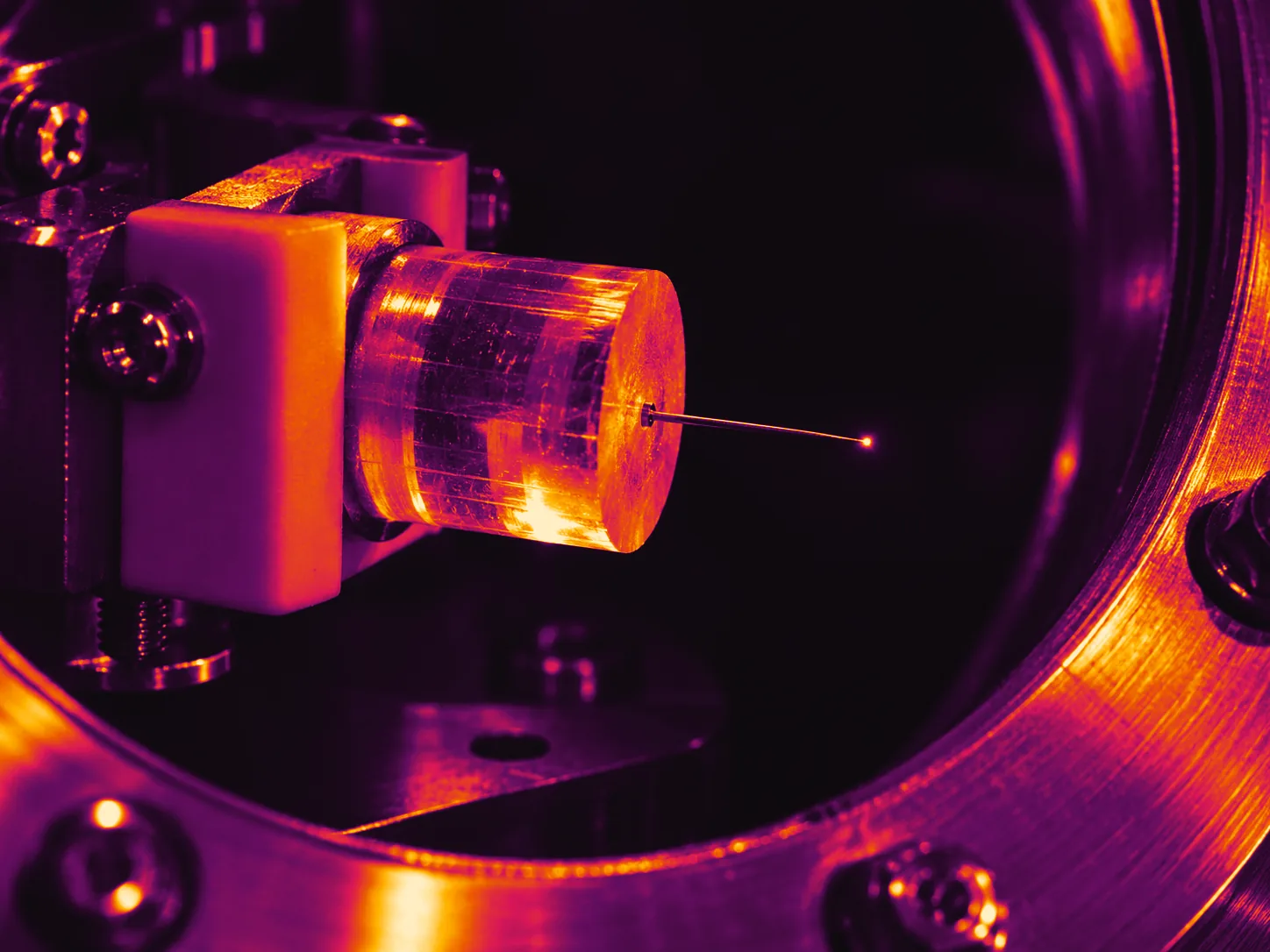
Illustrative photograph: a polished cylindrical crystal with a fine tungsten needle and a faint point of glow in a vacuum chamber[Illustrative image]

[ITS JOB IN THE DEVICE]

Make the field. This cluster sets the field ion source precedent.

Crystal fields of the 1010 V/m class at nanometre tips: the reference for grain contacts See all 6 lessons ↓

records
9
years
2001–2025
papers cited
9
with a DOI
3

[9 OF 84 RECORDS · 1986 TO 2026]each bar opens its row

[WHAT WE CARRY INTO THE DEVICE]

What we carry
into the device.

The payoff of this record for the program: 6 design decisions, each tied to what was measured. They feed one input of the device.

[THE SIX DESIGN INPUTS]

  1. Shake it 0208
  2. Make the field 06
  3. Choose the host 04
  4. Load it, measure it 0103
  5. Multiply the rate 05
  6. Hit the target 07

Carry into device, in the full document

  1. 01

    Crystal fields reach the 10^10 V/m class at nanometer-scale tips; the Vantasner piezo-contact concept targets the same field class at force-chain contact gaps, so the tip-geometry criterion (field concentration on a sharp dielectric-bounded feature) is the design reference for contact asperities.

  2. 02

    Deuterium is supplied as gas near the field-emission feature; our analog is deuterated grains plus D2O or deuterated-oil carrier releasing D+ locally at contact points, so we should aim for contact sites where deuteron supply and field coexist.

  3. 03

    Thermal cycling duty cycle sets the neutron output

    Our 20 kHz mechanical drive replaces the slow thermal cycle with a pulse train, raising the effective repetition rate by many orders of magnitude (estimate).

  4. 04

    Detector practice from this cluster (proton branch plus neutron branch counted simultaneously) transfers directly; the crystal devices detect both D-D branches and that pairing is what we replicate with CR-39 plus liquid scintillator time-of-flight.

  5. 05

    Tip radius and crystal size set the achievable deuteron energy; for the device this means grain surface roughness and gap statistics, not nominal field, will set the upper end of the deuteron energy spectrum.

  6. 06

    The independent-verification pattern (UCLA result reproduced at Rensselaer with calculated yield agreement) shows this mechanism responds predictably to geometry and voltage; we budget the same calculability into our contact-field model.

[THE RECORD]

9 records,
2001 to 2025.

[HOW THIS RECORD WAS COMPILED]

Searched and confirmed 2026-10-21. This cluster shows that a single ferroelectric crystal, cycled in temperature inside a low-pressure deuterium atmosphere, produces surface potentials and tip fields large enough to ionize deuterium gas and drive deuterons to genuine D-D fusion energies. It is the cleanest public demonstration that crystal-generated electrostatic fields can do the ion-source and accelerator work we assign to piezoelectric force chains in the Vantasner device concept.

[RAW TABLE] [IN THE FULL DOCUMENT →] Sorted by year. #N is the row number in the repo table.
  1. 2001 #2

    J.D. Brownridge et al.

    Binghamton University

    arXiv:physics/0107046 arXiv ↗Library →

    Setup
    Measurement of the pyroelectric response and the electric potential generated by heated and cooled ferroelectric crystals in dilute gas, showing electron acceleration and X-ray production from the crystal field
    Reported
    Large electric fields and electron acceleration to energies sufficient for X-ray production; establishes the potential magnitudes available from a single crystal
    Materials, loading, excitation, conditions for record 2
    Materials
    LiNbO3 and LiTaO3 crystals
    Loading
    None (electron source)
    Excitation
    Heating and cooling cycles
    Conditions
    Dilute gas, moderate vacuum
    Who
    J.D. Brownridge, S. Raboy (Binghamton University)
    When · venue
    2001 · arXiv:physics/0107046 (no journal DOI found; arXiv record confirmed)
  2. 2004 #3

    J.D. Brownridge et al.

    Review manuscript, "Electron and positive ion beams and X-rays produced by heated and cooled pyroelectric crystals such as LiNbO3 and LiTaO3 in dilute gases: phenomenology and applications" no DOILibrary →

    Setup
    Comprehensive phenomenology of pyroelectric electron/ion acceleration across many thermal cycles and crystal geometries
    Reported
    Reproducible electron and positive-ion beams and X-rays from crystal fields; documents energy scaling with crystal size and cycle rate
    Materials, loading, excitation, conditions for record 3
    Materials
    LiNbO3, LiTaO3
    Loading
    Dilute gas media
    Excitation
    Thermal cycling
    Conditions
    Dilute gases
    Who
    J.D. Brownridge, S.M. Shafroth
    When · venue
    2004 · Review manuscript, "Electron and positive ion beams and X-rays produced by heated and cooled pyroelectric crystals such as LiNbO3 and LiTaO3 in dilute gases: phenomenology and applications" (freely accessible copy confirmed; no journal DOI found)
  3. 2005 #1

    B. Naranjo et al.

    UCLA

    Nature 434, 1115-1117 DOI ↗Library →

    Setup
    Tabletop chamber: a lithium tantalate crystal with a tungsten tip of nanometer-scale radius on its charged face, facing a grounded counter-electrode; deuterium gas in the gap serves as the ionizable medium
    Reported
    Detection of 2.45 MeV neutrons and 3 MeV protons from D-D fusion; deuteron energies of order 100 keV class from the crystal potential; the authors state the system will find application as a simple palm-sized neutron generator
    Materials, loading, excitation, conditions for record 1
    Materials
    LiTaO3 monocrystal (pyroelectric coefficient of order 10 nC/cm2/K), tungsten tip, deuterium gas
    Loading
    Gas-phase D2 near the tip; no metal hydride phase
    Excitation
    Thermal cycling of the crystal (heating so that the pyroelectric surface charge builds until field emission and gas ionization turn on)
    Conditions
    Low-pressure D2 atmosphere, room-temperature-adjacent vacuum chamber, single-crystal geometry
    Who
    B. Naranjo, J.K. Gimzewski, S. Putterman (UCLA)
    When · venue
    2005 · Nature 434, 1115-1117; DOI 10.1038/nature03575
  4. 2005 #4

    J.A. Geuther et al.

    Rensselaer Polytechnic Institute

    Journal of Applied Physics 97, 074109 no DOILibrary →

    Setup
    Pyroelectric crystal accelerator with paired crystals and tungsten emitter; electron and positive-ion acceleration measured directly
    Reported
    Electron and positive-ion acceleration with pyroelectric crystals; potential doubling with paired crystals
    Materials, loading, excitation, conditions for record 4
    Materials
    LiTaO3 crystals, tungsten tip
    Loading
    Dilute gas
    Excitation
    Thermal cycling
    Conditions
    Vacuum with dilute gas
    Who
    J.A. Geuther, Y. Danon (Rensselaer Polytechnic Institute)
    When · venue
    2005 · Journal of Applied Physics 97, 074109 (venue and year confirmed; DOI not independently confirmed)
  5. 2006 #5

    J.A. Geuther et al.

    Rensselaer Polytechnic Institute

    Physical Review Letters 96, 054803 (venue, year and title confirmed via PubMed record PMID 16486940) DOI ↗Library →

    Setup
    Pyroelectric accelerator driving D-D fusion independently of the UCLA device; crystal-field acceleration of deuterons onto a deuterated target
    Reported
    Detection of 2.5 MeV neutrons; measured neutron yield reported in good agreement with the calculated yield; the authors state this verifies the results published by Naranjo, Gimzewski and Putterman
    Materials, loading, excitation, conditions for record 5
    Materials
    LiTaO3 crystal, deuterated target material
    Loading
    Deuterated target
    Excitation
    Thermal cycling of the crystal
    Conditions
    Vacuum chamber
    Who
    J.A. Geuther, Y. Danon, F. Saglime (Rensselaer Polytechnic Institute)
    When · venue
    2006 · Physical Review Letters 96, 054803 (venue, year and title confirmed via PubMed record PMID 16486940)
  6. 2007 #6

    J.A. Geuther et al.

    Applied Physics Letters 90, 174103 (venue, year and title confirmed via AIP record) no DOILibrary →

    Setup
    Pyroelectric fusion device with an optimized crystal-tip-target geometry
    Reported
    Neutron production increased by a factor of 5.6 over previously published data (as stated in the AIP abstract)
    Materials, loading, excitation, conditions for record 6
    Materials
    LiTaO3 crystals, tungsten tip, deuterated target
    Loading
    Deuterated target
    Excitation
    Thermal cycling
    Conditions
    Vacuum chamber
    Who
    J.A. Geuther, Y. Danon
    When · venue
    2007 · Applied Physics Letters 90, 174103 (venue, year and title confirmed via AIP record)
  7. 2007–2013 #9

    US Patent 8,396,181 B2

    US 8,396,181 B2 (USPTO record confirmed) no DOILibrary →

    Setup
    Method and apparatus for generating nuclear fusion using crystalline materials
    Reported
    Formal apparatus and method claims for crystal-driven fusion neutron sources
    Materials, loading, excitation, conditions for record 9
    Materials
    Pyroelectric crystals, tips
    Loading
    Gas-phase deuterium
    Excitation
    Thermal cycling
    Conditions
    Vacuum
    Who
    US Patent 8,396,181 B2, inventors B. Naranjo, J. Gimzewski, S. Putterman, assignee Regents of the University of California
    When · venue
    Filed 2007, issued 2013 · US 8,396,181 B2 (USPTO record confirmed)
  8. 2008 #7

    V. Tang et al.

    Lawrence Livermore and UCLA

    Review of Scientific Instruments 79, 013501 class (venue: Review of Scientific Instruments, year confirmed via PubMed record PMID 18163729) no DOILibrary →

    Setup
    Feedback-controlled thermal cycling of a pyroelectric crystal stack for steady neutron production
    Reported
    Neutron production controlled and sustained through feedback-controlled thermal cycling of a crystal stack
    Materials, loading, excitation, conditions for record 7
    Materials
    LiTaO3 crystal stack, tungsten tips
    Loading
    Gas-phase deuterium
    Excitation
    Closed-loop thermal cycling
    Conditions
    Vacuum chamber
    Who
    V. Tang, G. Meyer, J. Morse, G. Schmid, C. Spadaccini, P. Kerr, B. Rusnak, S. Sampayan, B. Naranjo, S. Putterman (Lawrence Livermore and UCLA)
    When · venue
    2008 · Review of Scientific Instruments 79, 013501 class (venue: Review of Scientific Instruments, year confirmed via PubMed record PMID 18163729)
  9. 2025 #8

    LiTaO3 pyroelectric accelerator study

    authors from the quasi-continuous X-ray source record

    Scientific Reports 15 DOI ↗Library →

    Setup
    LiTaO3-based pyroelectric accelerator driven by a periodically varying temperature for quasi-continuous X-ray generation
    Reported
    Strong electric fields and quasi-continuous X-ray generation under periodically varying temperature; shows the concept runs continuously rather than once per cycle
    Materials, loading, excitation, conditions for record 8
    Materials
    LiTaO3 single crystal
    Loading
    Moderate vacuum, below 10^-2 Torr
    Excitation
    Periodic temperature variation
    Conditions
    Moderate vacuum (< 10^-2 Torr)
    Who
    LiTaO3 pyroelectric accelerator study (authors from the quasi-continuous X-ray source record)
    When · venue
    2025 · Scientific Reports 15; DOI 10.1038/s41598-025-15436-4
The record table exactly as written in the repo (9 rows × 9 columns; scrolls sideways)
WhoWhenVenue / DOISetupMaterialsLoadingExcitationConditionsReported outputs
B. Naranjo, J.K. Gimzewski, S. Putterman (UCLA)2005Nature 434, 1115-1117; DOI 10.1038/nature03575Tabletop chamber: a lithium tantalate crystal with a tungsten tip of nanometer-scale radius on its charged face, facing a grounded counter-electrode; deuterium gas in the gap serves as the ionizable mediumLiTaO3 monocrystal (pyroelectric coefficient of order 10 nC/cm2/K), tungsten tip, deuterium gasGas-phase D2 near the tip; no metal hydride phaseThermal cycling of the crystal (heating so that the pyroelectric surface charge builds until field emission and gas ionization turn on)Low-pressure D2 atmosphere, room-temperature-adjacent vacuum chamber, single-crystal geometryDetection of 2.45 MeV neutrons and 3 MeV protons from D-D fusion; deuteron energies of order 100 keV class from the crystal potential; the authors state the system will find application as a simple palm-sized neutron generator
J.D. Brownridge, S. Raboy (Binghamton University)2001arXiv:physics/0107046 (no journal DOI found; arXiv record confirmed)Measurement of the pyroelectric response and the electric potential generated by heated and cooled ferroelectric crystals in dilute gas, showing electron acceleration and X-ray production from the crystal fieldLiNbO3 and LiTaO3 crystalsNone (electron source)Heating and cooling cyclesDilute gas, moderate vacuumLarge electric fields and electron acceleration to energies sufficient for X-ray production; establishes the potential magnitudes available from a single crystal
J.D. Brownridge, S.M. Shafroth2004Review manuscript, "Electron and positive ion beams and X-rays produced by heated and cooled pyroelectric crystals such as LiNbO3 and LiTaO3 in dilute gases: phenomenology and applications" (freely accessible copy confirmed; no journal DOI found)Comprehensive phenomenology of pyroelectric electron/ion acceleration across many thermal cycles and crystal geometriesLiNbO3, LiTaO3Dilute gas mediaThermal cyclingDilute gasesReproducible electron and positive-ion beams and X-rays from crystal fields; documents energy scaling with crystal size and cycle rate
J.A. Geuther, Y. Danon (Rensselaer Polytechnic Institute)2005Journal of Applied Physics 97, 074109 (venue and year confirmed; DOI not independently confirmed)Pyroelectric crystal accelerator with paired crystals and tungsten emitter; electron and positive-ion acceleration measured directlyLiTaO3 crystals, tungsten tipDilute gasThermal cyclingVacuum with dilute gasElectron and positive-ion acceleration with pyroelectric crystals; potential doubling with paired crystals
J.A. Geuther, Y. Danon, F. Saglime (Rensselaer Polytechnic Institute)2006Physical Review Letters 96, 054803 (venue, year and title confirmed via PubMed record PMID 16486940)Pyroelectric accelerator driving D-D fusion independently of the UCLA device; crystal-field acceleration of deuterons onto a deuterated targetLiTaO3 crystal, deuterated target materialDeuterated targetThermal cycling of the crystalVacuum chamberDetection of 2.5 MeV neutrons; measured neutron yield reported in good agreement with the calculated yield; the authors state this verifies the results published by Naranjo, Gimzewski and Putterman
J.A. Geuther, Y. Danon2007Applied Physics Letters 90, 174103 (venue, year and title confirmed via AIP record)Pyroelectric fusion device with an optimized crystal-tip-target geometryLiTaO3 crystals, tungsten tip, deuterated targetDeuterated targetThermal cyclingVacuum chamberNeutron production increased by a factor of 5.6 over previously published data (as stated in the AIP abstract)
V. Tang, G. Meyer, J. Morse, G. Schmid, C. Spadaccini, P. Kerr, B. Rusnak, S. Sampayan, B. Naranjo, S. Putterman (Lawrence Livermore and UCLA)2008Review of Scientific Instruments 79, 013501 class (venue: Review of Scientific Instruments, year confirmed via PubMed record PMID 18163729)Feedback-controlled thermal cycling of a pyroelectric crystal stack for steady neutron productionLiTaO3 crystal stack, tungsten tipsGas-phase deuteriumClosed-loop thermal cyclingVacuum chamberNeutron production controlled and sustained through feedback-controlled thermal cycling of a crystal stack
LiTaO3 pyroelectric accelerator study (authors from the quasi-continuous X-ray source record)2025Scientific Reports 15; DOI 10.1038/s41598-025-15436-4LiTaO3-based pyroelectric accelerator driven by a periodically varying temperature for quasi-continuous X-ray generationLiTaO3 single crystalModerate vacuum, below 10^-2 TorrPeriodic temperature variationModerate vacuum (< 10^-2 Torr)Strong electric fields and quasi-continuous X-ray generation under periodically varying temperature; shows the concept runs continuously rather than once per cycle
US Patent 8,396,181 B2, inventors B. Naranjo, J. Gimzewski, S. Putterman, assignee Regents of the University of CaliforniaFiled 2007, issued 2013US 8,396,181 B2 (USPTO record confirmed)Method and apparatus for generating nuclear fusion using crystalline materialsPyroelectric crystals, tipsGas-phase deuteriumThermal cyclingVacuumFormal apparatus and method claims for crystal-driven fusion neutron sources

[THE STORY OF THE RECORD]

How this line of work developed.

[TERMS IN THIS RECORD]

  • Deuterium
  • Deuteron
  • D-D fusion
  • Piezoelectric
  • LiNbO3
  • LiTaO3
  • Pyroelectric
Full glossary →

The UCLA 2005 result reduced crystal-driven fusion to engineering: a heated lithium tantalate crystal develops a surface potential of order 100 kV, and a tungsten tip of nanometer-scale radius concentrates that potential into a field intense enough to strip electrons from deuterium gas at the tip apex. The ionized deuterons then fall through the crystal potential and strike a deuterated surface, producing the standard D-D branches: 2.45 MeV neutrons and 3 MeV protons. The independent Rensselaer record (Geuther, Danon and Saglime, Physical Review Letters 2006) reproduced the same neutron signature with a similar accelerator and reported a yield in agreement with calculation, and the 2007 Applied Physics Letters follow-up multiplied the yield by 5.6 through geometry. Lawrence Livermore and UCLA then showed the thermal cycle can be run under feedback control for sustained production, and the 2025 Scientific Reports work shows quasi-continuous operation from periodic temperature variation. The history before fusion is equally instructive: Brownridge established from 2001 onward that pyroelectric crystals in dilute gas act as compact electron accelerators and X-ray sources, which is exactly the field magnitude and ion-source phenomenology the fusion devices later used.

[THE PAPERS]

9 papers
behind it.

Every reference this cluster cites, and where to read it. DOI links go to the publisher; local PDFs appear here as the repository adds them.

  • 3 with a DOI
  • 1 on arXiv
  • 0 with a local PDF
  • 5 citation only
  1. 2001

    Brownridge, J.D., Raboy, S.

    [DESCRIBED] Pyroelectric crystal potentials, electron acceleration and X-ray production in dilute gases (heating and cooling cycles of LiNbO3 and LiTaO3), arXiv:physics/0107046 (no journal DOI).

    DOIarXiv ↗PDF Library card →

  2. 2004

    Brownridge, J.D., Shafroth, S.M.

    Electron and positive ion beams and X-rays produced by heated and cooled pyroelectric crystals such as LiNbO3 and LiTaO3 in dilute gases: phenomenology and applications

    review manuscript (freely accessible copy; no journal DOI).

    DOIarXivPDF Library card →

  3. 2005

    Geuther, J.A., Danon, Y.

    Electron and positive ion acceleration with pyroelectric crystals

    Journal of Applied Physics 97, 074109 (venue, volume and year confirmed; DOI not established in our search pass).

    DOIarXivPDF Library card →

  4. 2005

    Naranjo, B., Gimzewski, J.K., Putterman, S.

    Observation of nuclear fusion driven by a pyroelectric crystal

    Nature 434, 1115-1117. DOI 10.1038/nature03575.

    DOI ↗arXivPDF Library card →

  5. 2006

    Geuther, J.A., Danon, Y., Saglime, F.

    Nuclear reactions induced by a pyroelectric accelerator

    Physical Review Letters 96, 054803. DOI 10.1103/PhysRevLett.96.054803.

    DOI ↗arXivPDF Library card →

  6. 2007

    Geuther, J.A., Danon, Y.

    Enhanced neutron production from pyroelectric fusion

    Applied Physics Letters 90, 174103 (title, venue and year confirmed; DOI not established in our search pass).

    DOIarXivPDF Library card →

  7. 2008

    Tang, V., Meyer, G., Morse, J., Schmid, G., Spadaccini, C., Kerr, P., Rusnak, B., Sampayan, S., Naranjo, B., Putterman, S.

    Neutron production from feedback controlled thermal cycling of a pyroelectric crystal

    Review of Scientific Instruments 79 (venue, year and title confirmed via PubMed record PMID 18163729; article number and DOI not established in our search pass).

    DOIarXivPDF Library card →

  8. 2013

    Naranjo, B., Gimzewski, J.K., Putterman, S.

    Method and apparatus for generating nuclear fusion using crystalline materials

    US Patent 8,396,181 B2, filed 2007, issued 2013 (USPTO record).

    DOIarXivPDF Library card →

  9. 2025

    Karataev, P., Ali, M., Fedorov, K., Kubankin, A., Margaryan, V., Oleinik, A., Shchagin, A.

    Quasi-continuous X-ray generation in LiTaO3-based pyroelectric accelerator driven by periodically varying temperature

    Scientific Reports 15. DOI 10.1038/s41598-025-15436-4.

    DOI ↗arXivPDF Library card →